Erwin Suess
The SwarmErwin Suess is a senior scientist at the GEOMAR Centre whose work turns the investigation of anomalous deep-sea worms from a story about suspicious organisms into a warning about an unstable system. Working with geochemists and biologists, he helps expose the mistaken assumptions behind the first explanation of the worms, models how a methane-hydrate blowout can occur, and presses for action when the evidence points toward a possible Storegga Slide. His importance lies not in claiming certainty, but in recognizing when an apparently tidy scientific account has failed to explain what is happening.
Position and scientific method
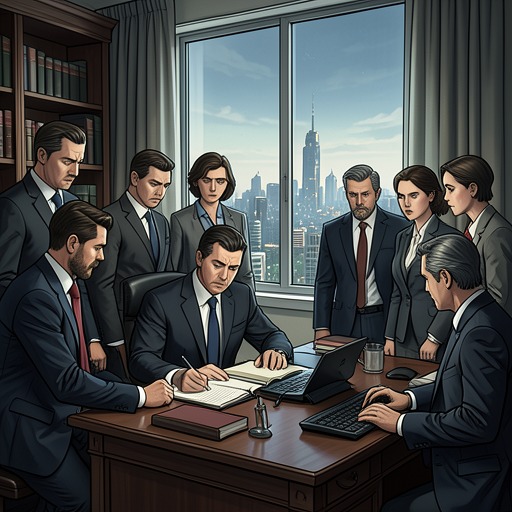
Two days after the accident aboard the Sonne, Suess and his team were examining sediment cores and material held in cold-storage tanks at the GEOMAR Centre. The samples had been sent to Kiel by express freight, and the researchers had begun tests without delay. After twenty-four hours of continuous work, their computer simulation appeared to have revealed the truth about the worms. When Gerhard Bohrmann returned, Suess was waiting at the control panel with Heiko Sahling and Yvonne Mirbach, a molecular biologist specializing in deep-sea bacteria.
Suess presents the simulation as an explanatory instrument rather than the discovery itself: the team does not need it to understand the result, he says in effect, but it will help explain that result to others. This distinction defines his practical role. He is concerned both with reconstructing the mechanism and with making the findings legible beyond the immediate research group. The computer model is not a substitute for evidence; it is a way to show how the evidence fits together.
Revising the explanation of the worms
The crucial correction concerns symbiosis. Suess identifies that the worms carry bacterial communities: one set of organisms colonizes the inside of a worm, while another lives on its skin, with different bacterial species working in tandem. Earlier reports had recognized the relationship between worms and symbiosis, but, as Suess explains, had drawn the wrong conclusions because researchers had not asked what the bacterial consortia were doing. The working premise had been that the worms themselves destabilized the hydrate ice, even though that explanation could not account for the process.
Suess redirects attention from the visible animal to the less conspicuous biological system associated with it. When Bohrmann asks whether the worms are merely transporters, Suess confirms the distinction and turns to the simulation of the blowout. The image shows a worm opening its pincer-like jaws and burrowing into the ice; the model then traces the process that produced the eruption. The point is not simply that the worms are present, but that their presence had been read as the cause when it was only part of a larger mechanism.
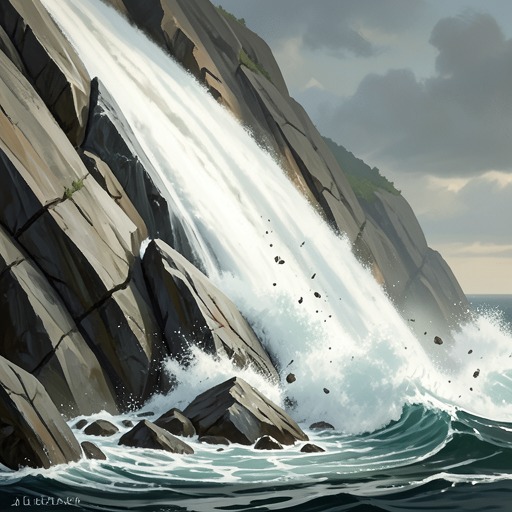
That correction matters because the consequences of hydrate instability can amplify. Later, Yvonne Mirbach explains that the first simulation had relied on largely linear assumptions, whereas the real developments may be chaotic and, in some cases, exponential: crumbling ice allows gas to escape, the escaping gas cracks more hydrates, and the seabed begins to collapse. Suess recognizes the force of this revised analysis. He repeats that Johanson must be contacted and directs the team to tell him they are predicting a Storegga Slide. The prediction remains uncertain, but Suess treats uncertainty as a reason to communicate the danger, not to wait for certainty that may arrive too late.
Warning beyond the research group
The warnings create a conflict between scientific disclosure and institutional secrecy. When Bohrmann cannot reach Johanson, he and Suess consider who else in Johanson’s circle could make a decision. Bohrmann points out that the matter cannot simply be left with the Statoil group: if a Storegga Slide occurs, keeping the warning quiet would look indefensible. Suess accepts that judgment and proposes contacting the Ministry for Science and Technology and environmental authorities. He then widens the proposed notification to officials in Oslo, Berlin, Copenhagen, Amsterdam, and London.
This is a consequential shift from modeling a danger to carrying it into public and governmental channels. Suess does not claim that the event is certain, and the evidence does not show him resolving the political dispute around confidentiality. Instead, it shows him choosing a route for warning beyond the immediate industrial circle when the scale of the possible disaster makes silence harder to justify. His action makes the scientists’ uncertainty part of the warning: the exact timing and outcome are unknown, but the chain of events they are modeling is serious enough to demand attention.
Communication interrupted by the disaster
Suess’s effort to circulate information is later thwarted by the very seabed collapse his group had forecast. From the GEOMAR Centre, he sends an email containing growth curves for the worm colonies and estimates of what comparable invasions might mean elsewhere. The message travels through the fiber-optic network and along TAT 14, a transatlantic cable that links Europe and the United States. But the shelf and seabed have been destroyed; the cable has been severed, and the transmission is lost before it can reach Gerhard Bohrmann at Chateau Whistler.
The interruption has immediate scientific consequences. A week after the disaster in northern Europe, transatlantic Internet traffic is at a standstill, and Bohrmann is left waiting for the file while the researchers in Kiel continue working flat out. The missing message contains not a general update but specific growth curves and estimates that could help assess similar worm invasions in other parts of the world. Suess’s email thus becomes a concrete instance of the crisis disabling the means by which its causes and risks might be shared: the information exists, but the physical network that carries it has failed.
Continuing expertise as the crisis deepens
Suess remains important to the investigation after the initial explanation has been revised. At a later operation involving the removal of worms from a hydrate terrace, Bohrmann is exhausted and says he is the only one who knows enough about hydrates. He is reminded that the team knows enough to continue, and that Suess is expected to arrive by helicopter from Kiel. When the question of who should take part in a deep-sea dive arises, Bohrmann again points to Suess’s expertise, saying that Suess knows at least as much as he does, probably more. The scenes establish Suess as a trusted specialist whose knowledge can support work beyond the original modeling, while stopping short of showing what he does once he arrives.
Across these episodes, Suess’s role is to keep revising the explanation as the evidence changes and to carry that explanation toward the people who must act on it. The worms first appear to be the direct destabilizing force; his team’s findings instead distinguish the animals from the bacterial consortia they transport. The resulting account does not make the crisis simpler: it reveals a more complicated and potentially accelerating chain of effects. Suess’s insistence on simulation, reconsideration, and warning gives the novel’s scientific inquiry a public consequence, while the severed cable underscores how fragile communication becomes when the disaster is already underway.